
Ventilation is a critical part of mining with the constant supply of air being needed by the miners and horses to survive. Explosive gases (firedamp) were rare in Cleveland, but not totally unknown, a gas explosion at Lingdale in 1953 killed 8 miners. Lack of oxygen (blackdamp) is main danger locally, this can very quickly cause death by suffocation.
In the early days of mining it was sufficient to ventilate with a furnace at the bottom of a shaft, this acts like a simple chimney with rising hot air drawing the fresh air into the mine. It does however require a constant supply of fuel and supervision.
, 
The next major development was fans on the surface driven by steam engines, the most popular design locally being the Guibal Fan invented in 1860, when ironstone mining was booming. It consisted of a large wooden fan moving at a relatively low speed (30-50 rpm). The remains of these fans can be seen at the “SS Castle” at Eston and at Huntcliffe.


Between 1910-1920 most local mines switched from steam to electricity, at this point it became possible to use smaller, faster Sirocco fans (300 rpm)

Samuel Cleland Davidson with a huge centrifugal fan he designed and manufactured, probably for ventilating a mine shaft, at the Sirocco Engineering Works, Belfast. This is a scan of a family photo in the Bleakley Family archive owned by the copyright holder. This file is licensed under the Creative Commons Attribution-Share Alike 4.0 International
A modern reconstruction can be viewed at the Cleveland Ironstone Mining Museum, whilst an in-situ example slowly rusts away at Grinkle.

Photo from Northern Echo

Hi Chris – really enjoying reading about the local history in this area.
Question though about ventilation.
Looking at the enormous scale of the mine workings under Skelton (where I live), I would expect to see far more old air shafts around Skelton to provide adequate ventilation to such a large underground infrastructure. For example, the Guibal Fan (which draws air out of the mine), would only be effective if there were corresponding air inlet points all around it. Any thoughts?
Hi Mark,
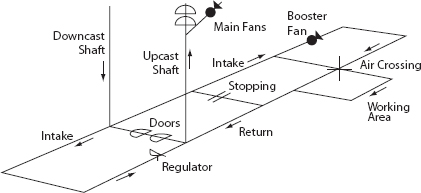
Normally you have one big fan on the upcast shaft, this pulls the air in via the downcast shaft.
Then it’s directed all around the mine with a series air doors and stoppings, before being pulled out of the upcast shaft.
As you progress you block up old passages and areas no longer used with stoppings, so the air is directed to the working areas where its needed.