
This payslip from North Skelton mine is dated 9th November 1935, it gives a huge amount of information on the operation of an ironstone mine. Thanks to Gavin Brett for sharing it.
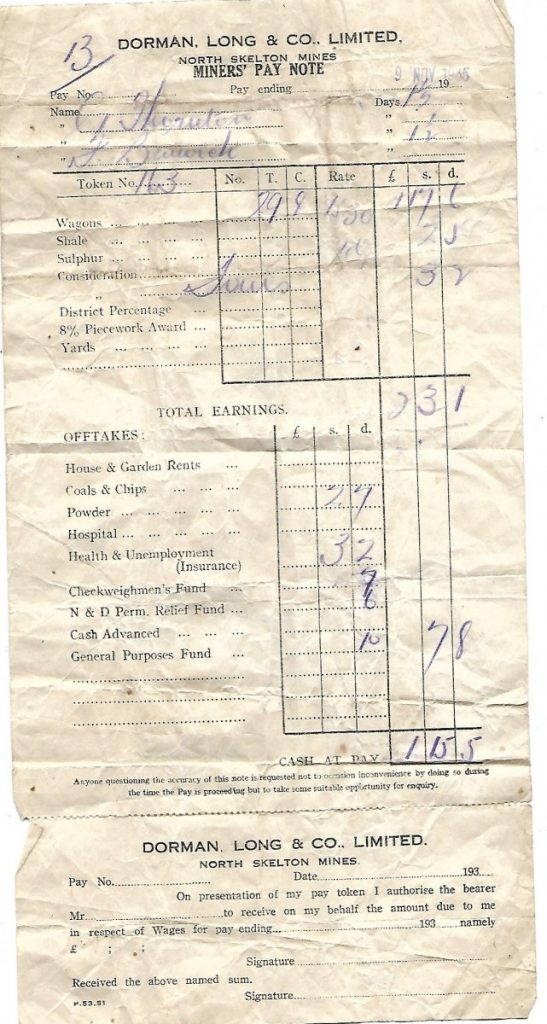
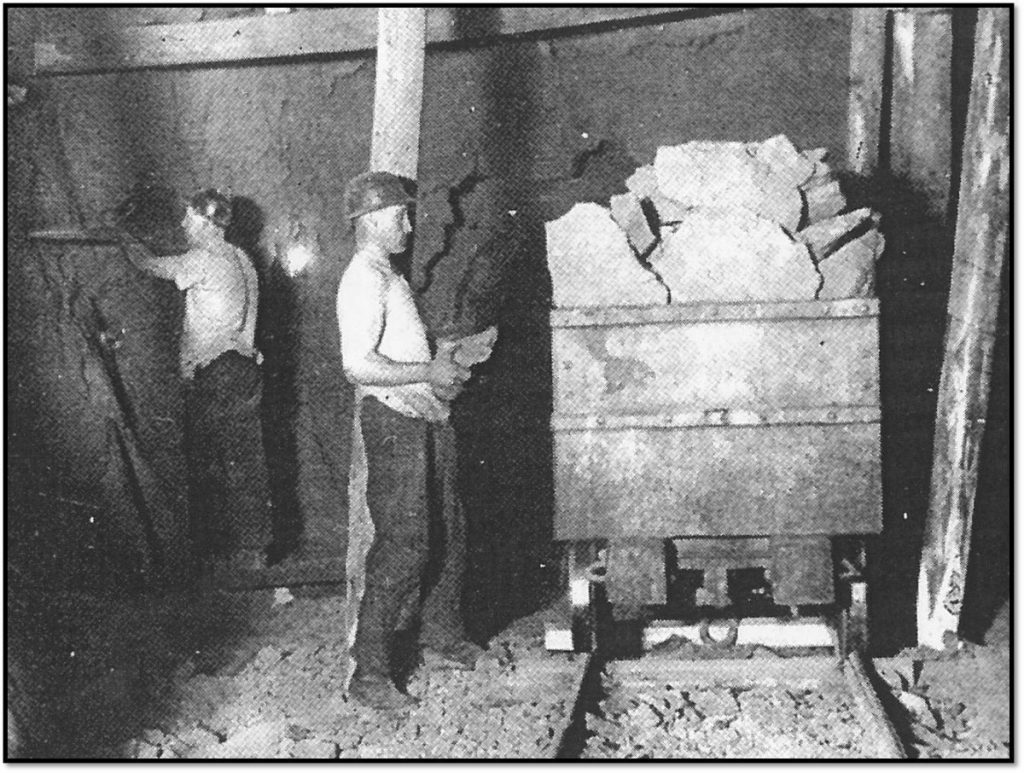
The first point is that it’s the payslip for two miners, Thornton and Barwick. Miners worked in pairs with one drilling and one loading. Their token number was 163, which they would have put inside the tub so the tonnage was recorded against them on the surface.
The two miners have extracted over 29 tons and were paid a rate of 1 shilling and 3 pence per ton. Different rates would have been paid for shale (a useless by-product) and sulphur (a thin band exists above the ironstone and was used in the early chemical industry)
A “District Percentage” might be paid if difficult conditions (like incoming water) in certain areas made the mining difficult. ‘Yards’ would be paid for driving tunnels that were required but possibly not in the valuable ironstone.
Now the part the miners would have hated, the deductions!
“House and Garden rent” would be payable by those living in company-owned houses. With “Coal and Chips” being fuel for their fires.
“Powder” is the charge for the explosives being used, these essential materials are not provided by the company and had to be purchased by the miner!
“Hospital” the miners themselves had to fund the Hospital / Doctors / Nurses who would help them if they had an accident at work. No free NHS and nothing provided by employers as there would be now.
“Health and Unemployment Insurance” seems likely to have been brought in as part of the National Insurance Act 1911. In 1935 there was no Welfare State / National Health Service Service to cover people in those circumstances.
“Checkweighmans Fund” the miners employed a weighman of their own to ensure their individual tonnages were correctly weighed (clearly they didn’t trust the companies own staff to be on their side !)
“Northumberland and Durham Miners Permanent Relief Fund” was established in 1862, following the Hartley Pit Disaster, for provision of relief to miners and their families in case of fatal accidents or permanent disablement. The equivalent of modern Life Insurance, the fund was only wound up in 1995.